Description
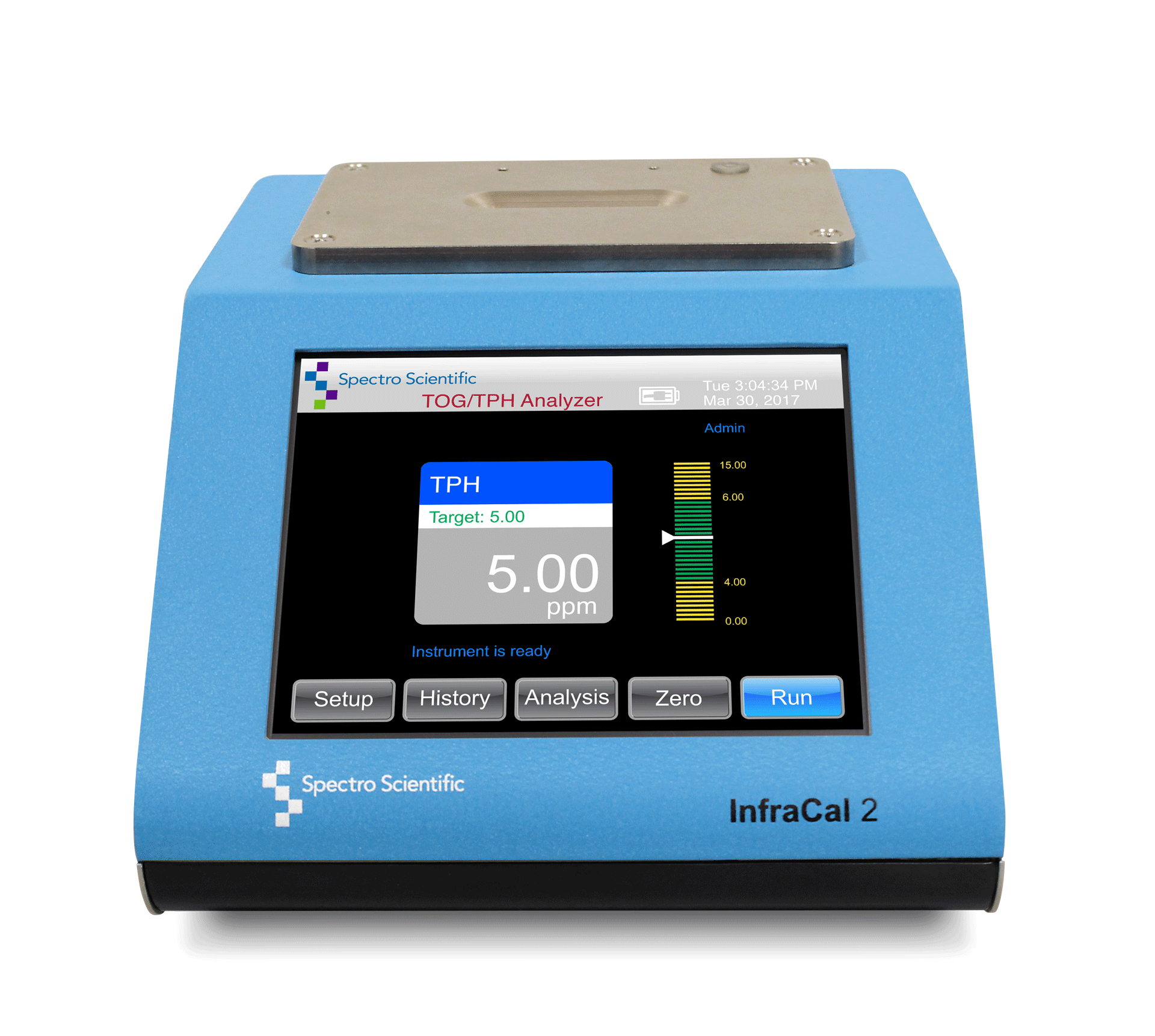
The InfraCal Model ATR-SP is recommended for measuring oil in water, TPH(Total Petroleum Hydrocarbons) in soil or FOG(Fats, Oil & Grease) in wastewater concentration levels when using hexane, pentane or Vertrel MCA as the extracting solvent. Measurement data obtained with this analyzer will correlate to EPA Method 1664 as both procedures are based on evaporation techniques and measuring the residual oil and grease. The analyzer is equipped with a built-in cubic zirconia horizontal attenuated total reflection (HATR) stainless steel sample stage. The InfraCal 2 ATR-SP is a direct replacement for the original InfraCal HATR-T2 used worldwide for the determination of TOG/TPH in water and soil.
As offshore oil wells age, the increase of produced water challenges wastewater treatment systems. In order to ensure oil levels in the water are under the regulatory limit, it is important to do regular testing. Infrared analysis has been used for off-shore oil in water measurements for over 45 years. Infrared is an accepted oil content measurement as it is least affected by changes in produced water composition.
For industrial pretreatment of wastewater and public water treatment plants a simplified procedure for monitoring FOG discharges can avoid fines, sanitary sewer overflows (SSOs) and give on-site results in less than 15 minutes rather than waiting days or weeks for an off-site laboratory result.
The InfraCal 2 has added features such as touch screen display, data storage and transfer, a multi-language interface and password protected settings. The internal battery pack allows for portability and up to 6 hours continuous use.
Operating Principle
The InfraCal 2 ATR-SP analyzer is designed to measure solvent extractable material (oil and grease) by infrared determination in water or soil using hexane, pentane, cyclohexane or Vertrel MCA for the extraction procedure. A detector with a fixed 3.4 μm (2940 cm-1) filter is used to measure oil and grease concentrations. The ATR-SP correlates with EPA Methods 1664 as well as with the ASTM D7066 Method and EPA 413.1 and 418.1.
The ATR-SP makes use of the fact that oil and grease can be extracted from water or soil using an appropriate solvent and extraction procedure. The extracted hydrocarbons absorb infrared energy at a specific wavelength and the amount of energy absorbed is proportional to the concentration of hydrocarbons in the solvent. The analyzer can be calibrated to read out directly in the desired units such as %, ppm, mg/L or mg/kg.
The touchscreen display includes the capability for multiple calibrations, a wizard guide for calibration, multilevel user database, multiple languages with user preference selection, high/low alarm and control limits, and measurements stored in a history table for recall or export to a flash or serial port.

FAQ's
What is the LOD of the InfraCal 2 ATR-SP?
The InfraCal 2 ATR-SP has a minimum detection limit of 0.3 ppm for oil in water and 3 ppm for oil in soil.
What is the highest range of measurement for the ATR-SP?
The InfraCal 2 ATR-SP can be calibrated to measure up to 15% oil in water or soil.
How long does the calibration last?
A calibration lasts anywhere between one year and many years depending on frequency of use and environment. We recommend you do an annual calibration verification and recalibrate when necessary.
Why do the standards read differently than the value on the label?
If the instrument is calibrated for a 10:1 extraction, the standard will read approximately a factor of 10 lower than the labeled value of the standard. For example, a standard labeled 500 ppm will read 50 ppm. For instruments calibrated for a 1:1 extraction, the instrument will read approximately the labeled value of the standard.
Which solvents can be used with the ATR-SP?
The most common solvents used with the InfraCal 2 ATR-SP are Hexane and Pentane. However, the ATR-SP can be used with any volatile hydrocarbon solvent with low evaporation residue.
How much solvent do you need for an analysis?
The required amount of solvent is dependent on the measurement range. For calibrations using a 10:1 extraction ratio the measurement typically requires 10 – 25 ml of solvent depending on the sample size. For calibrations using a 1:1 extraction ratio the measurement typically requires 25 – 100 ml of solvent depending on the sample size.
How long can you wait in between sample collection and analysis?
You can wait several days after sample collection before measuring the sample. If the sample is not to be measured within a few hours, you MUST acidify the sample to a pH of 2 using HCl or Sulfuric Acid.
Is the instrument sensitive to temperature?
For high precision measurements (below 10 ppm) it is recommended the instrument be used in a temperature controlled environment. Less precise measurements are not as sensitive to temperature, however, the instrument should not be placed near a heating or cooling source.
Does the Instrument require any special maintenance?
No. We recommend keeping the instrument clean and dry. A plastic dust cover is supplied with the instrument.
How do you clean the sample trough?
Using a lint-free, non-abrasive cloth and solvent, wipe in one direction. Repeat with isopropyl alcohol. For more specific instructions, refer to the manual.
How long does the source last?
The InfraCal 2 ATR-SP source has a typical life span of 5+ years.
Do you turn the instrument off when not in use?
If you are continuously using the instrument it is not necessary to turn the instrument off as there is a required minimum 30 minute warm time. If you are not going to use the instrument regularly we recommend turning the instrument off.
New High Range Measurement of Oil In Water or Soil
The InfraCal 2 analyzer with an ATR sample stage can now be used for measuring the 0.5-10% range of oil in water or soil. The sample is extracted using a solvent that does not have an infrared absorbance at the hydrocarbon wavelength and, therefore, does not require evaporation. Measuring the extract directly in the solvent, instead of evaporating off the solvent, allows for percent range measurements with the same ATR sample stage used to measure the ppm levels.
- Measurement Range Water: 0.5 – 10%
- Measurement Range Soil: 0.5 – 10%
- Solvents: S-316, Tetrachloroethylene
 Tunnel to Towers Foundation